
Guides
Fence contractor insurance: coverage explained and priced
Fence contractor insurance explained by the claims this trade produces, with real coverage types and the figures that decide what a fencing business pays.
What to take away
- General liability for a two to four person fencing crew commonly runs $1,200 to $4,500 a year in most states, and workers compensation runs $6 to $18 per $100 of payroll for fence erection, a class code your state assigns.
- Commercial auto on a truck and trailer is typically $1,800 to $4,200 a year per vehicle, and inland marine covering tools and materials runs $500 to $1,500.
- A $1,000 deductible turns a $900 lawn repair into an out-of-pocket cost, so match the deductible to the size of claim you actually file.
- Ask for the policy wording, not the summary, and read the exclusions on underground services and defective work before renewal.
Work from the claim backward
Most insurance conversations start with a price and end with a product nobody has read. Reverse it. List what goes wrong on a fencing job, then ask a broker how the proposed wording responds to each.
S. fencing contractor, not quotes. Your rate depends on payroll, work mix, claims history, state and limits. Treat them as the shape of the cost, then get a real number. S. only; Canadian contractors buy similar cover through provincial workers compensation boards, and those rates are set separately.
What the coverage costs
| Coverage | Typical annual premium | Rated on |
|---|---|---|
| General liability | $1,200 to $4,500 | Revenue, payroll, subcontractor use |
| Workers compensation | $6 to $18 per $100 payroll | Class code, experience modifier |
| Commercial auto | $1,800 to $4,200 per vehicle | Driver records, radius, trailer weight |
| Inland marine (tools, materials) | $500 to $1,500 | Declared value of the schedule |
| Commercial umbrella | $700 to $2,500 per $1M | Underlying limits, trade |
Workers compensation is the line that moves most. Fence erection carries a class code your state sets, and a single lost-time claim can raise your experience modifier for three years. A crew of four at $45,000 payroll each pays roughly $10,800 to $32,400 a year at those rates, which is why the modifier matters more than the base rate.
The National Council on Compensation Insurance lists class 6400 for fence erection, and most states adopt that number. States with their own rating bureaus, including California, New York, New Jersey, Pennsylvania and Texas, publish their own code for the same work, so confirm the code on your policy.
Rates follow state loss cost filings, not the year on the cover. For a 2027 renewal, ask your broker for the filed loss cost change behind your class code. Ask also for the renewal date, and start the review a month before it.
The claims this trade produces
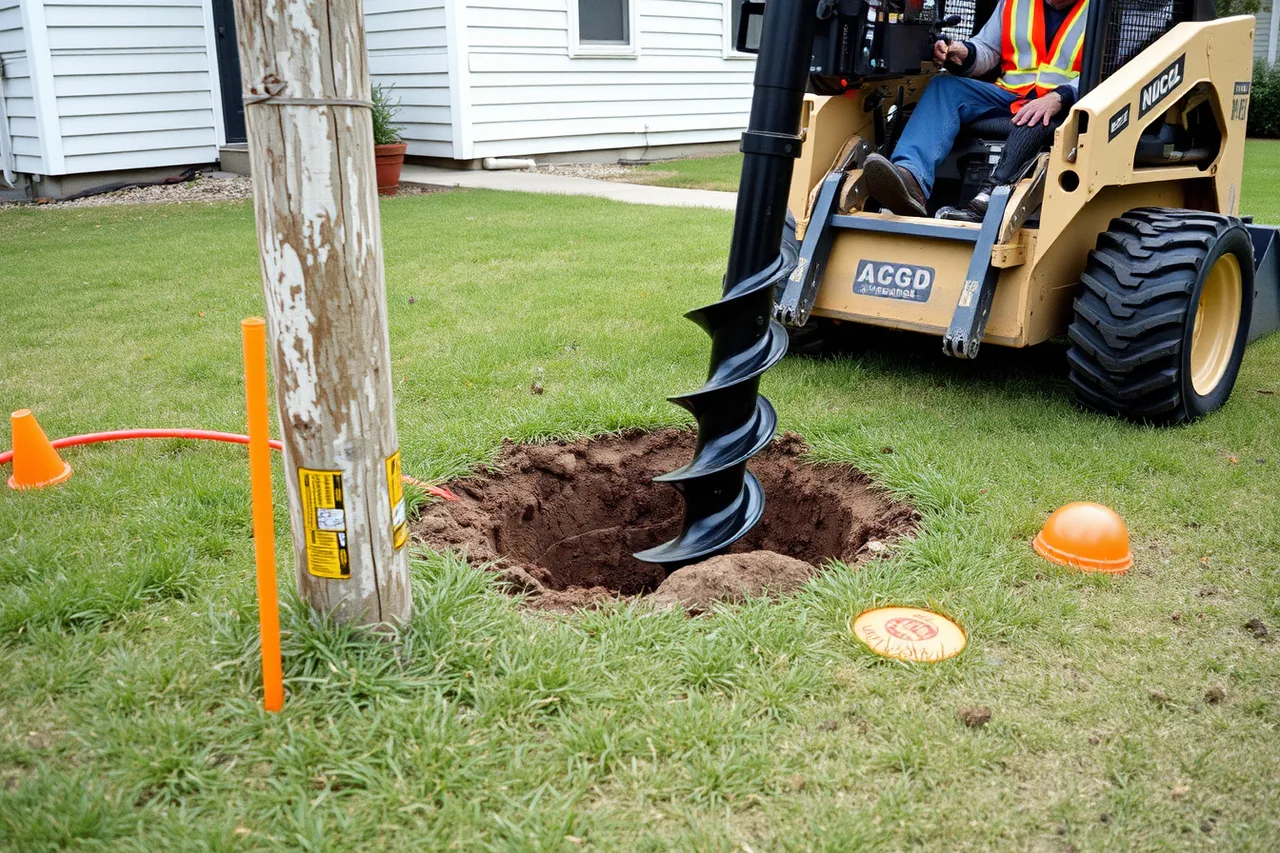
A struck utility. The auger goes through a service that was unmarked or outside the marks that were honored. The cost is the repair plus the outage and emergency response. Ask how the wording treats underground services and whether locating compliance is a condition.
A fence built over the property line. Discovered by a neighbor, a survey or a sale. The usual outcome is removal and reinstatement. Ask what responds when the defect is the location of correct work rather than the quality of it.
A gate injury. Gates are heavy, they move, and children use them. A leaf that comes off a hinge or a latch at the wrong height on a pool barrier is foreseeable. Ask about completed operations, which responds after you leave the site.
Damage during access. Ruts across a lawn, a cracked driveway, an irrigation line cut by a hand tool. Small and frequent. Ask what the deductible does to claims this size.
Injury to your own crew. Digging, lifting panels and working above grade produce ordinary construction injuries. Workers compensation thresholds are set by each state. Check your state's workers compensation board or commission, such as the New York State Workers' Compensation Board or the Texas Department of Insurance Division of Workers' Compensation.
Property in transit and on site. Tools stolen from a truck, materials taken from an unattended site. Ask where cover starts and stops, since site and transit are often handled differently.
Vehicle use. The truck and trailer are the largest moving thing the business owns. Ask how business use is treated and what happens with an employee driving.
Turning the list into questions for a broker
Questions for a broker
- For each claim above, ask which section of the proposed wording responds and read that section.
- Ask for the exclusions that apply to your work, particularly around underground services and defective work.
- Ask what conditions you must meet for cover to hold, such as documented utility locating.
- Ask how completed operations are treated and for how long after the job.
- Ask what your customers and general contractors require you to carry, because that often sets the floor.
- Ask what evidence you will be asked for at claim time and start keeping it now.
The records that decide claims
Claims in this trade are won or lost on what you can show. Photographs of the locate marks before digging, with dates. The signed scope stating the boundary assumption. The dated note of what the building department said about depth. Completion photographs showing gate clearance and gap at grade.

None of that is exotic, and all of it is easier to collect than to reconstruct. It is the same evidence that keeps the compliance side of fence work defensible, and it belongs in the same file as the registrations covered in what licenses a fence contractor business needs.
Reducing the exposure before insuring it
Insurance prices risk. Reducing the risk is cheaper than insuring it.

The Occupational Safety and Health Administration: Safety Management recommended practices set out a program built on leadership, worker participation, hazard identification and control, training and review.
Where any work is above grade, the Occupational Safety and Health Administration: Fall Protection in Residential Construction guidance describes the controls expected. On commercial sites with public access, the U.S. Department of Justice: ADA Guide for Small Businesses covers duties that a gate or barrier can engage.
The practical measures are unglamorous: locate before every hole and re-request when a job slips, write the boundary assumption into the quote, size gate posts for the leaf they carry, and photograph the site before the machine goes on it. Each one removes a category of claim.
Carrying the premium into job pricing
Carry the premium into the fence contractor business plan as an annual figure and into job costing as a rate per crew day.
Review equipment cover whenever the kit changes, so keep the fence contractor equipment and setup guide decisions and the asset list together. The equipment checklist for new owners is a reasonable starting point for the schedule an insurer asks you to declare.
The claim list as an agenda
Claim list as an agenda
| Claim | The question to put to a broker | Evidence you would need |
|---|---|---|
| Struck utility | How are underground services treated, and is locating a condition? | Ticket reference and dated photographs of the marks |
| Fence over the line | What responds when correct work is in the wrong place? | Quote stating the boundary source |
| Gate injury | How are completed operations covered, and for how long? | Completion photographs and hardware specification |
| Access damage | What does the deductible do to small frequent claims? | Site condition photographs before any machine moved |
| Crew injury | What does my state require, and how are subcontractors treated? | Training records and the written safety routine |
Common questions
What does fencing insurance actually cost?
For a small U.S. fencing contractor, several insurance costs apply:
What fencing insurance costs
- $1,200 to $4,500a yearGeneral liability typically runs .
- $6 to $18per $100 of payrollWorkers compensation costs .
- $1,800 to $4,200per vehicleCommercial auto runs .
- $500 to $1,500Inland marine costs .
Your state, payroll, work mix and claims history move those numbers. A broker who knows the trade can narrow the range for your circumstances.
Do I need workers compensation for one employee?
Requirements and thresholds are set by each state, and some capture the first employee while others do not. Check your state's workers compensation board or commission, then ask how subcontractors are treated, because that is where operators get caught. The premium is rated per $100 of payroll against a class code the state assigns.
Will the policy cover a fence built in the wrong place?
Read the wording. Cover for the cost of redoing your own work is treated differently from cover for damage to someone else's property, and this scenario can touch both. This is exactly the question to put to a broker in writing.
Does calling 811 protect me?
It substantially reduces the exposure and it is the expected standard of care, but only if the marks were honored, still valid, and documented. The photograph of the marks with a date is what turns a phone call into evidence.