Guides
How Vancouver fence contractors quote cedar and composite in a wet climate
Fence builder quotations in Vancouver must price BC Building Code rules, Street and Traffic By-law setbacks, rain-screened systems and cedar or composite costs.
What to take away
- A fence builder quotations package in Vancouver has to price BC Building Code fence requirements, City of Vancouver Street and Traffic By-law setbacks, and rain-screened systems, not just panels and posts.
- Cedar and composite behave differently in Vancouver rain, so a quote needs a species or product line, a finish schedule and a realistic replacement horizon.
- Boulevard and front yard fences sit closest to the by-law line, so survey, permit and setback work belongs in the scope and the price.
- Wet climate quotation impact shows up in post footings, board shrinkage, fasteners, drainage and access, and it should be visible to the client.
- A quote that separates labour, materials, disposal and contingency survives a Vancouver winter better than a single lump sum.
BC Building Code fence requirements for Vancouver contractors
Fence work in Vancouver is not governed by one simple fence clause. The BC Building Code fence requirements that matter most are the ones attached to what the fence does: retaining soil, guarding a drop, enclosing a pool, or acting as a site barrier.

A fence that retains more than a trivial amount of earth is a retaining structure, and Division B of the BC Building Code treats it that way. Pool and hot tub barriers are covered by Section 9.35 of Division B. The barrier must be at least 1.2 m (about 4 ft) high, with a self-closing, self-latching gate.
A fence used as a guard at a deck edge or a steep grade change must meet Article 9.8.7.1. That article sets guard heights at 900 mm to 1 070 mm (about 3 ft to 3 ft 6 in). None of that is optional in a quotation.
For most residential cedar and composite fences, the practical code issues are height, wind exposure, post embedment and the connection to the ground. Vancouver is a coastal city with wind-driven rain, so lateral load and footing depth are not academic.
Wind load comes from Article 4.1.7.1 of Division B. Post size, embedment depth and footing size follow from that load and from the soil on site.
Local contractors also work alongside Canadian Standards Association standards for wood preservation and fencing materials, and provincial worker safety rules. The CCOHS standards page is a useful starting point for the compliance side of the work, including the standards that apply to treated wood, fasteners and site safety CCOHS: Standards.
Quotation habit: list the code basis for each fence run. If a fence is a guard or a pool enclosure, say so. If it is a simple privacy fence on a flat lot, say that too. The client is paying for a defensible scope, not a vague promise.
Vancouver Street and Traffic By-law setbacks and boulevard fences
The City of Vancouver Street and Traffic By-law (No. 2849) controls fences that sit on, over or beside a street, lane or boulevard.
Fence height in yards comes from the Zoning and Development By-law (No. 3575). Section 10.7 caps a fence in a required front yard at 1.2 m (about 4 ft), and district schedules can be tighter.
Those rules are separate from the BC Building Code fence requirements and they catch contractors who only check the building side.
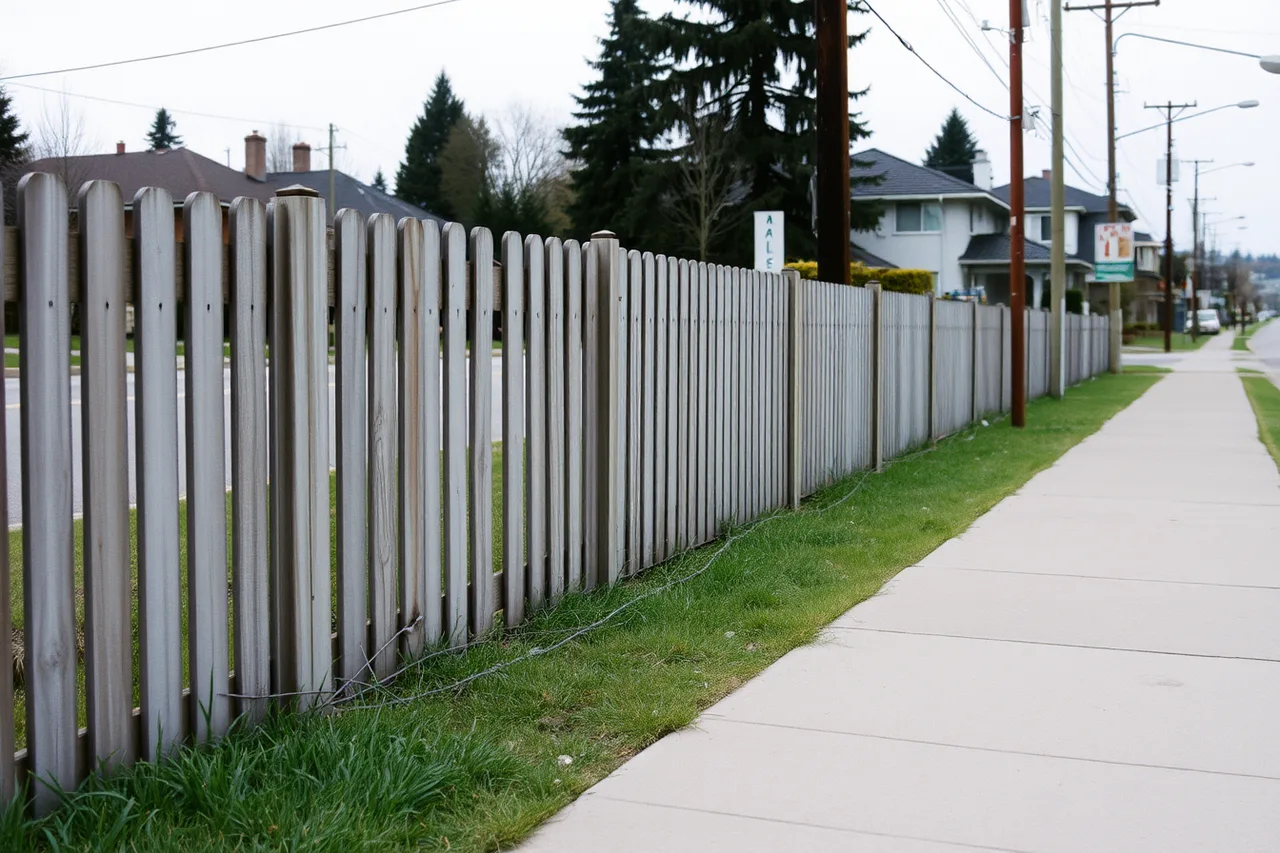
On a typical Vancouver lot, the front yard and the boulevard strip are the sensitive areas. There is no single front-yard setback distance in the by-law. A fence has to sit inside the surveyed property line and behind the street boundary on a boulevard.
Corner lots also have to keep the sight triangle clear. The City measures that clearance from the property corner, and street and lane width set the number at permit stage.
Boulevard fences usually need a street use approval. Before quoting, confirm the survey, the frontage, the corner clearance and any boulevard planting. A fence that crosses a boulevard without approval is a callback, a removal cost and a damaged reputation.
Setback work is also a pricing issue. A tight front yard means hand digging, smaller equipment and more time. Put that in the quote as a priced line item rather than absorbing it. For a structured way to present that line item, see our guide to a quote, line by line.
Rain-screened fence systems for a wet climate
Rain-screened systems are the main technical response to Vancouver rain. A rain screen holds the boards off the framing or uses a drained cavity so water runs down and out instead of soaking into end grain and joints.
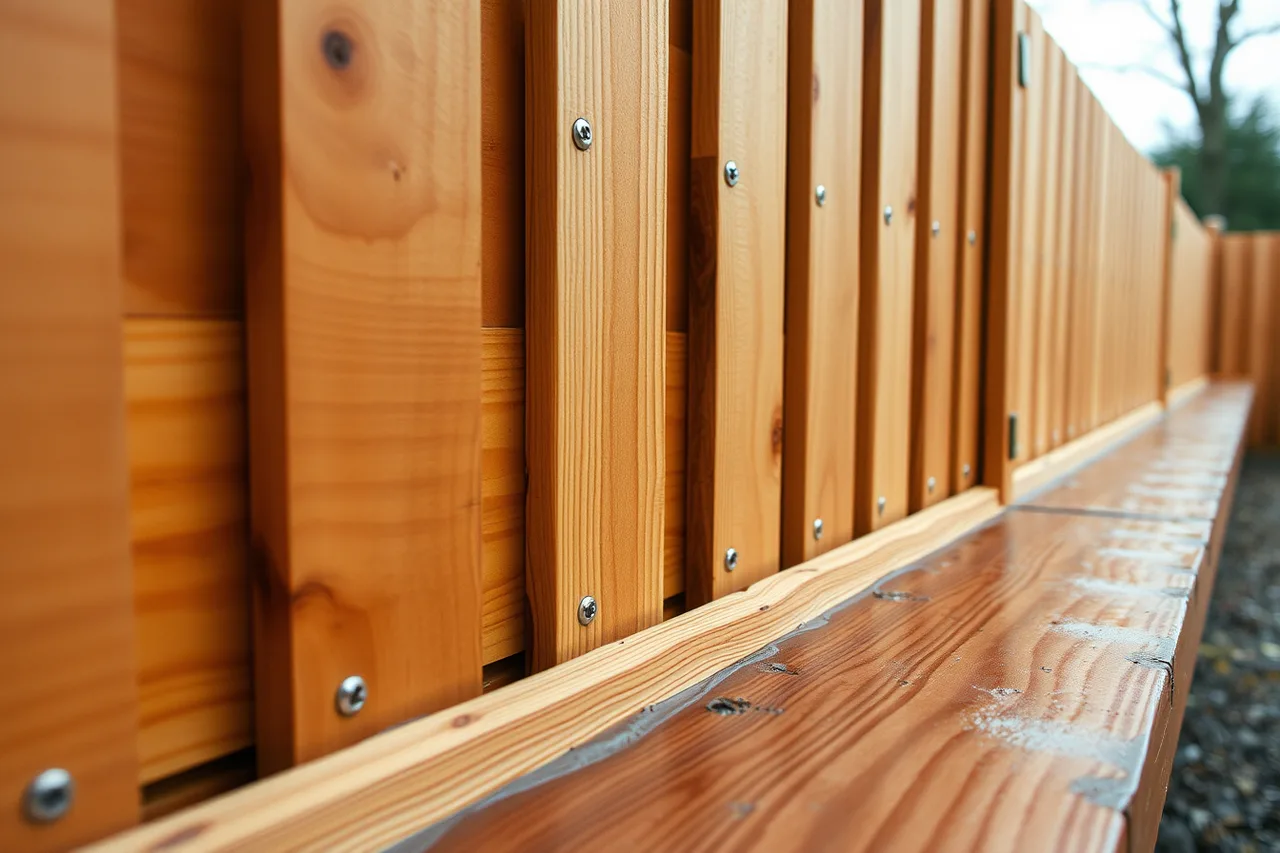
In a wet climate, a fence without a drainage path stays damp for days after a storm. That drives rot at the post base, fastener corrosion and finish failure. A rain-screened fence system costs more up front and lasts longer, which is exactly the trade a Vancouver client should see.
Components that matter: a 10 mm to 19 mm (3/8 in to 3/4 in) drained cavity, stainless fasteners, a cap detail and a footing that sheds water away from the post.
Suppliers sometimes stock a 3/8 in (10 mm) drainage mat, such as Benjamin Obdyke Cedar Breather, or you can rip pressure-treated battens rated for ground contact. For fasteners, specify Type 316 stainless steel screws. Simpson Strong-Tie's EPB and ABA elevated post bases hold the post end above grade and out of the wet.
Cedar and composite both benefit from rain screening, but for different reasons. Cedar needs air movement to dry. Composite needs a drainage path to avoid staining and trapped moisture at the framing.
Quote rain screening as a named system, not as a vague upgrade. Say what the spacer is, what the fastener is, and how the base drains. That is the difference between a warranty you can honour and one you cannot. Our service quality honest checklist covers how to document that promise.
Cedar versus composite material costs in Vancouver
Cedar fence cost Vancouver clients see depends on species, grade, board size and finish. Western red cedar is the local standard, and clear or tight-knot grades cost more than utility grades. Prices move with mill supply, so a quote should carry a validity window.
As a typical range, a six-foot cedar privacy fence installed in Metro Vancouver runs about $45 to $75 per linear foot. A gate adds roughly $500 to $900. Those are typical figures, not a quote, because labour rate, access and footings move them.
Composite fence Vancouver pricing depends on the product line, the profile and the warranty. Composite is usually the higher material cost, but it can reduce finishing and some maintenance labour. It also behaves differently in heat and cold, so expansion details matter. Typical installed pricing runs about $70 to $120 per linear foot, before any narrow-access charge.
Cedar versus composite material costs
Cedar
- Material cost
- Lower to mid
- Finish and sealing
- Needed, recurring
- Wet-climate behaviour
- Swells, dries, can cup
- Fasteners
- Stainless or coated
- Repair
- Board-by-board
- Client expectation
- Natural, ages
Composite
- Material cost
- Mid to high
- Finish and sealing
- Minimal
- Wet-climate behaviour
- Stable, needs drainage
- Fasteners
- Manufacturer spec
- Repair
- Panel or section
- Client expectation
- Uniform, low upkeep
Use the table as a talking point, not a price list. Real numbers come from your supplier and your labour rate. For the margin side, see our guide to pricing and profit.
A worked example helps clients choose. Take a 30-foot rear privacy fence in East Vancouver, six feet high, with four posts and a gate.
Cedar versus composite material costs
- Measure the run and confirm the property line and any easement.
- Choose cedar or composite and name the grade or product line.
- Price framing, boards, fasteners and a rain-screened detail.
- Add footings, concrete, disposal and access time.
- Add finish, permit review and a contingency line.
At those typical rates, that 30-foot run lands at roughly $1,850 to $3,150 in cedar and roughly $2,600 to $4,500 in composite, gate included. Hand digging in a tight front yard pushes the top of the range. Treat the totals as illustrative and price the job from your own labour rate and supplier quote.
That structure keeps cedar and composite comparable without hiding the wet-climate work. It also makes the quote easy to audit later.
How wet-climate conditions change a Vancouver fence quotation
Wet climate impact is not one line. It lands in the ground, the materials, the schedule and your overhead, and ignoring it is how a profitable job turns into a repair call.
Start with the ground. Vancouver soils can stay saturated, so post holes may need more concrete, deeper embedment or a different base detail. Hand digging in a tight yard adds hours that a dry-climate quote would miss.
Next, materials. Wet boards shrink as they dry, so cedar spacing and fastening need to allow movement. Composite needs drainage and correct clearances. Both need fasteners that will not stain the surface after a season of rain.
Then, scheduling. Rain days, short daylight in winter and wet ground push work into fewer productive hours. A quote that assumes a dry-week install is optimistic. Build weather allowance into the schedule and the price.
Finally, business overhead. BC taxes and tax credits affect what you remit and what you can claim, so keep quotes and invoices consistent with your registration Taxes and tax credits - Province of British Columbia.
Small business supports in the province can help with the admin side as you grow Resources and support for businesses and entrepreneurs in B.C. - Province of British Columbia.
A good Vancouver quote shows the client what rain does to the fence and what you are doing about it. That is also how you defend your price. For the rate side, read Charging properly for fence contractor services, and for the gear that keeps wet-season installs on schedule, see equipment rated on what actually matters.
- Property line and survey confirmed
- BC Building Code basis noted for guards, pools and retaining
- Street and Traffic By-law setback and boulevard review done
- Rain-screened system specified by component
- Cedar or composite named with grade or product line
- Wet-weather schedule and contingency priced