Guides
Fence Contractor Winter Installation: Dealing with Frost and Frozen Ground
Fence contractor winter installation runs into frozen ground, heave and short daylight. Here is what frost depth rules out and when to stop digging.
What to take away
Fence contractor winter installation is limited by frozen ground, not by willingness to work. The methods below apply wherever frost depth exceeds what a hand auger can cut.
- In the US, design frost depth is set locally by the adopted building code, so the permit office's number controls the footing depth.
- Frost penetration in Canada commonly reaches 1.2 m to 2.4 m in Prairie and Northern markets, so posts set in winter cannot reach bearing depth by hand.
- Frost depth varies by province and city, so a winter method that works in Victoria may fail in Saskatoon.
- Frozen ground rules out hand augers, small auger trucks and any footing poured into a hole you cannot clean.
- The workaround stops being worth it once you are drilling through more than about 300 mm of frozen cap per hole.
- Scheduling, not technique, is the real winter skillbook the work for late fall or wait for spring thaw.
What the constraint removes
Winter installation is a hard limit, not a preference. It is measured in frost depth, and frost depth is published. In Calgary and Winnipeg, design frost depth is often cited between 1.8 m and 2.4 m. In much of southern Ontario it sits nearer 1.2 m. The frost-depth post footings guide walks through how those numbers turn into footing depths on a quote.
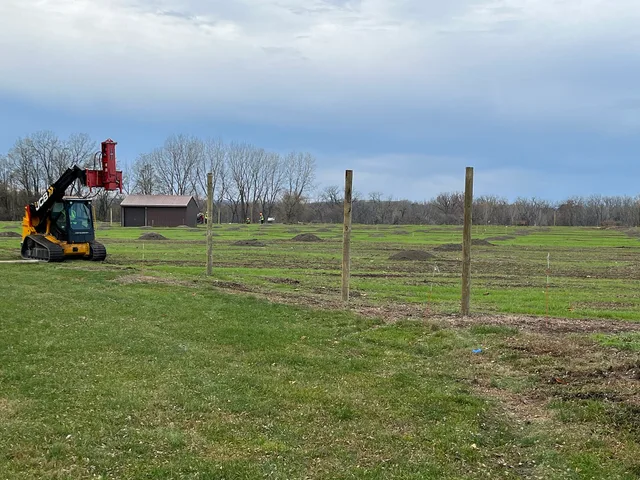
A hand auger will not cut frozen ground. Neither will a compact towable auger. Once the top 200 mm to 400 mm of soil is frozen, you need either a rock auger on a skid steer or a breaker, and both cost money per hour.
Cold-weather methods go beyond breaking the cap. A frost auger with carbide bits can cut frozen soil, and a ground-thawing machine or hot-water probe can open a hole where the cap is too thick to drill. For concrete, a non-chloride accelerator and a heated blanket or insulated curing box keep the pour above freezing. These methods add hours and equipment to every hole, and a winter quote should show them as separate line items.
The deeper problem is heave. A footing that does not sit below the frost line will move when the ground expands and contracts. That movement lifts posts, opens gates and cracks rails. No winter technique fixes a shallow footing.
Frost depth in the United States
In the United States, frost depth is not a single national number. The International Residential Code and International Building Code leave the design frost depth to local amendments and the local building official, so the number that matters comes from the permit office, not a supplier. State contractor licensing boards set the license and insurance rules, and OSHA publishes cold-stress guidance for winter crews. US frost depths are stated in feet and concrete curing limits in Fahrenheit, so convert before you quote.
What still works
Frozen ground does not stop all fence work. It changes what is possible.
- Steel and aluminum posts set on surface-mounted base plates over an existing concrete pad
- Repairs and gate adjustments on fences already standing
- Rail, picket and panel fabrication in a heated shop, installed later
- Layout, staking and permit work for spring jobs
- Removal and disposal of old fencing
Surface-mounted posts work where a concrete slab already exists and is thick enough. They are common on commercial sites. They are not a substitute for a buried footing on a residential property line.
Shop fabrication is the strongest winter play. You cut, weld, stain and assemble indoors, then install in a single short window. That converts a slow winter job into a fast spring one.
The compromises worth making
One compromise holds up: pour footings in late fall before the ground closes, then set posts and panels in winter. The concrete cures under a blanket, the holes are already at depth, and the winter crew only handles assembly.
A second compromise works in mild coastal markets. In Greater Vancouver and parts of Vancouver Island, frost depth is shallow enough that a standard footing often clears it. The Vancouver cedar and composite guide covers how wet-climate materials behave when installation runs into rain rather than frost.
A winter quote should name the frost depth it is designed to, the source for that number and the date the footing was poured. If it names none of those, the price is a guess.
The compromises that are not worth it
Do not dig a shallow hole and hope. A post set 600 mm deep in a market with 1.8 m frost depth will heave within one or two seasons. The repair costs more than the original footing.
Do not pour concrete into a hole with frozen walls or loose ice. The concrete will not bond, and the failure stays hidden until the first thaw cycle. A change order that adds depth after the fact is cheaper than a rebuild.
Do not use expanding foam or gravel packs as a frost substitute. They are drainage products, not structural ones.
Do not promise a firm install date in January in Manitoba or Saskatchewan. Weather holds are normal, and a contract that ignores them invites a dispute. Ontario's prompt payment and lien rules under the Construction Act set timelines that a stalled winter job can easily breach.
The threshold for stopping
There is a point where the workaround costs more than waiting. Treat it as a measurable line.
Keep going
- Frozen cap per hole
- Under 300 mm
- Drilling time per hole
- Under 15 minutes
- Daytime high
- Above -5 C
- Concrete cure window
- 48 hours above 5 C
Stop and reschedule
- Frozen cap per hole
- Over 300 mm
- Drilling time per hole
- Over 30 minutes
- Daytime high
- Below -10 C
- Concrete cure window
- No window available
When two or more signals sit in the stop column, the honest move is to quote the job for spring. Tell the client why, in writing, and hold the price. A contractor who explains frost depth plainly wins the spring job anyway. The provincial building codes guide shows how to fold that reasoning into a written quotation; in Canada that means named codes such as the Ontario Building Code, and in the US it means the local building official's adopted International Residential Code or International Building Code.
What a winter quote should show
A winter quotation should list the parts that frost changes: mobilization and thawing, per-hole drilling through frozen cap, concrete and accelerator, heated curing blanket or enclosure, extra post length to reach bearing depth, and a weather-hold clause. If those are collapsed into one square-foot price, the customer cannot see which part is winter risk. The same line items also make a spring reschedule easy to price.
Scheduling practice by region
Winter scheduling is not one national calendar.
- Prairies:installation window closes in late October and reopens in April. Frost depth is the deepest in the country.
- Ontario and Quebec:work often continues into December in the south. Northern Ontario behaves like the Prairies.
- Atlantic Canada:coastal frost is shallower but wind and freeze-thaw cycles damage poorly set posts. See the Halifax and St. John's materials guide.
- British Columbia:lower mainland work runs year round; interior markets do not.
A crew that works across two of these regions needs two sets of assumptions. One quote template will not cover both. The quote template with pricing examples is a starting point for separating them.
Scheduling across US frost regions
US winter scheduling follows the same logic but shifts by latitude and local code. Northern-tier states from the Upper Midwest and northern Plains to New England have the longest frozen-ground season, while mid-Atlantic and southern markets rarely lose digging to frost. The permit office's frost depth and the crew's drilling speed set the cutoff, not the calendar alone. A quote for a Minnesota or North Dakota job should carry a wider weather-hold window than one for Virginia or Tennessee.
Common questions
Can you pour concrete in frozen ground?
Does frost depth change the price of a fence?
Is winter work cheaper for the customer?
What happens if a post heaves?
For the tax and registration side of quoting winter work, CRA's GST/HST rate guidance sets out when to charge and collect.