
Guides
New versus used fence contractor gear: costs, risks and resale
New versus used fence contractor gear is compared on cost per productive day, with specific machines, wear points and resale channels for each option.
What to take away
- Compare cost per productive day, not sticker price. It folds acquisition, running cost, repair exposure and resale into one number.
- Used equipment usually wins on purchase price and loses on downtime. A week off in digging season is the cost that never comes back.
- Match the machine to the grounda towable auger for fence lines, a skid steer for rock, a mini excavator for post holes in tight yards.
- Resale runs through IronPlanet, Machinery Trader, Ritchie Bros. and Kijiji, and the channel decides what you recover.
- Hire for one season first and log the days used. That record is the only honest basis for buying.
Cost per productive day, in named quantities
Fill these from your own records. No figure from anywhere else belongs in the calculation.
Cost per productive day inputs
- Acquisitionpurchase, freight, immediate repair
- Residualexpected resale recovery
- Holding periodworking days, not calendar years
- Running costfuel, consumables, wear parts, service
- Repair exposureunscheduled repairs over holding period
- Downtime daysunavailable days, including parts wait
- Productive daysdays the machine actually worked
Cost per productive day is acquisition minus residual, plus total running cost, plus repair exposure, divided by productive days.
The trap is that used equipment wins on the first term and loses on the last two. A machine bought cheaply that sits a week in your busiest month has saved nothing, because a lost fencing day in a short season does not come back.
Run the calculation twice: once with the downtime you hope for, once with a pessimistic figure. If used only wins in the optimistic case, you are betting rather than buying.
The machines, by name
Towable hydraulic augers. The Dingo TX 1000 and the Toro TRX walk-behind units suit fence lines where a truck and trailer can reach the run. New runs roughly $8,000 to $15,000 depending on bit size and drive. Used units hold value well because the gearbox is the whole machine.
New vs used machine prices
Machine
- Towable hydraulic augers
- $8,000-$15,000
- Skid steers with auger
- $45,000-$75,000
- Mini excavators
- $60,000-$95,000
- Hydraulic post drivers
- $6,000-$12,000
- Concrete mixers
- $1,500-$4,000
- Trailers
- $6,000-$12,000
New
- Towable hydraulic augers
- holds value well
- Skid steers with auger
- $18,000-$30,000
- Mini excavators
- $25,000-$40,000
- Hydraulic post drivers
- close to new
- Concrete mixers
- cheap, rarely financed
- Trailers
- easiest resale
Used
- Towable hydraulic augers
- Skid steers with auger
- Mini excavators
- Hydraulic post drivers
- Concrete mixers
- Trailers
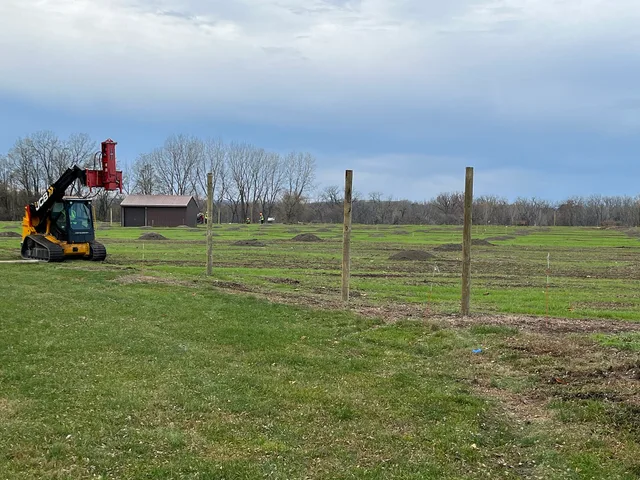
Skid steers with auger attachments. Bobcat S650 and Caterpillar 262D are the common fence-work carriers. New sits near $45,000 to $75,000. A ten-year-old unit with 3,000 hours often asks $18,000 to $30,000. The attachment matters more than the carrier for post holes.
Mini excavators. Kubota KX series and Bobcat E series dig post holes in tight yards and rocky ground. New runs $60,000 to $95,000. Used machines at 4,000 hours commonly list $25,000 to $40,000, and the undercarriage is where the money hides.
Hydraulic post drivers. Shaver and Danuser make the drivers most fence crews mount on a skid steer. New runs $6,000 to $12,000. Used drivers are simple and rarely fail, so the used market is thin and prices stay close to new.
Concrete mixers. A towable Mortar Max or Imer mixer handles footing pours. New runs $1,500 to $4,000. Used mixers are cheap and rarely worth financing.
Trailers. A 14-foot tandem-axle flatdeck is the standard fence trailer. New runs $6,000 to $12,000. Used trailers are the easiest resale in the fleet and the easiest to buy badly.
These are working ranges, not quotes. Get current pricing from a dealer or an auction result before you commit.
What actually wears
The parts that fail are the parts in the ground and the parts that carry load.
On an auger, check the gearbox and its seals, the output shaft for play, the bit teeth and the pilot, and the mounting. Play at the shaft is expensive. Worn teeth are cheap.
On a mini excavator, check the tracks and undercarriage, the pins and bushings, the hydraulic hoses at the flex points, and whether a repaint hides where it leaked. On any engine-driven tool, check how it starts cold, not how it runs warm.
On a trailer, the answer is usually brakes, bearings and lights. None are exciting, and all three stop you legally moving.
An inspection protocol for used equipment
- Ask for the service record before you look at the machine. If none exists, price repair exposure as if the machine has had none.
- Inspect cold. Start it from cold in front of the seller and listen. A warmed-up machine hides the faults you would meet at seven in the morning.
- Load it. A machine that runs freely can still fail under load, and digging is a load test.
- Check ground-touching parts first, load-carrying parts second, cosmetics last. Reverse that order and you buy a clean machine that cannot dig.
- Confirm parts availability for that model before you buy. A cheap machine with a long parts lead time is a downtime machine.
- Confirm you can transport and store it. Weight on a lawn and width through a yard gate are what strand it on site.
- Write down what you assumed about repair exposure so you can check it against reality in a year.
Resale value and where it goes
Resale is not a single number. It depends on the channel, the season and the paperwork.
Resale channels compared
Channel
- Ritchie Bros., IronPlanet
- fast
- Machinery Trader
- weeks
- Kijiji, Facebook Marketplace
- local
Speed
- Ritchie Bros., IronPlanet
- public, lower
- Machinery Trader
- higher
- Kijiji, Facebook Marketplace
- small gear
Price
- Ritchie Bros., IronPlanet
- Machinery Trader
- Kijiji, Facebook Marketplace
Auction channels like Ritchie Bros. and IronPlanet move equipment fast and price it publicly, which suits a machine you want gone this month.
Dealer listings on Machinery Trader reach a national buyer pool and usually clear higher, but the machine may sit for weeks.
Kijiji and Facebook Marketplace work for trailers, mixers and small augers, where the buyer is another contractor within driving distance.
The paperwork is what separates a good resale from a bad one. A machine with a service log, original manuals and a recent inspection sells faster and for more than an identical unit with none, because the buyer's risk is lower.
Resale also moves with the season. Selling a skid steer in November, when every crew is parking equipment, is a different market from selling in April.
Hire as the third option
Hiring converts the whole question into a variable cost and gives you the one thing the calculation above is missing: real data on how many days you would have used the machine.
Hire first, then buy
Do you have real days-used data?
buy against evidence
hire for a season and record days
Hire for a season, then record days used and what the machine saved against hand digging, and buy against evidence. That protects cash while the operation is young, which the fence contractor business plan should treat as the binding constraint.
The wider reasoning on what a fencing crew needs is in the fence contractor equipment and setup guide. The day-to-day load-out is in the equipment checklist for new owners.
The obligations that do not change with age
Used machines meet the same standard as new ones. Occupational Safety and Health Administration: Safety Management recommended practices cover finding and controlling hazards and training exposed workers. This applies to a secondhand auger exactly as to a new one.
Where any part of the work is above grade, Occupational Safety and Health Administration: Fall Protection in Residential Construction guidance applies regardless of equipment cost.
Operator competence is part of the purchase, not a separate matter, which is why buying capability belongs alongside hiring and training a fence crew. Registration or endorsement requirements for particular equipment are local and sit with the compliance side of fence work.
Keep the purchase, maintenance and disposal documents. The Internal Revenue Service: What kind of records should I keep? guidance describes keeping supporting documents for purchases and assets, and those are the same records that let you compute residual honestly next time.
Common questions
Is used always cheaper?
No. Used is usually cheaper to acquire and more expensive to run. Whether it is cheaper overall depends on downtime, which depends on the specific machine rather than on the category.
How do I estimate repair exposure with no history?
Assume the machine has had no maintenance and price accordingly, then treat anything better as a bonus. Sellers who have records produce them. Sellers who do not are telling you something.
Should a first machine ever be new?
If it is the machine your week depends on and you have no way to hire one quickly, the reliability is worth paying for. If a hire yard nearby can cover you in a day, used is a reasonable risk.
What about warranty?
Read what it actually covers and how long a claim takes, because the downtime during a claim is your cost either way. A warranty that pays for a part but leaves you without a machine for two weeks in the digging season is worth less than it looks.