Guides
Cross-border fencing compared for Canadian contractors serving US clients
Fence contractor business operations across the Canada-US border need customs paperwork, currency risk cover, cross-border insurance and clear contract terms.
What to take away
- Cross-border fence contractor business operations turn on four things: customs paperwork, currency risk, cross-border insurance and contract differences.
- You need a Canadian business number with an import account before fence materials cross either border, and a US employer identification number before you invoice a US client.
- Price US jobs in US dollars, but hold your costs in Canadian dollars and build a currency clause into the quote.
- Standard Canadian general liability policies often exclude US work, so ask your broker for US exposure in writing.
- Canadian and US lien rules differ, and the deadlines are short enough that a missed notice can cost you the whole invoice.
- GST/HST still applies to much cross-border work, and the place-of-supply rules decide which rate you charge.
Customs paperwork for Canadian fence contractors serving US clients
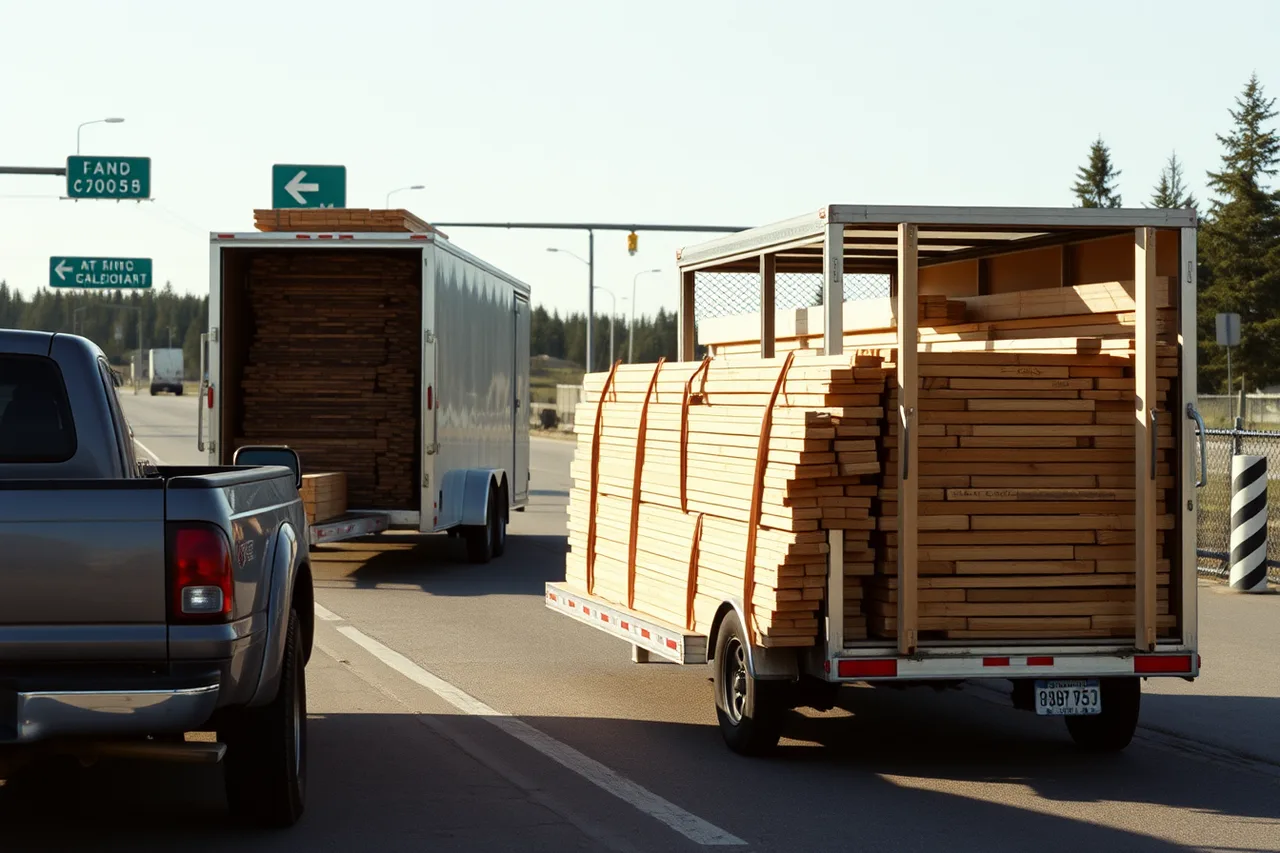
Customs paperwork is the first gate on any cross-border job, and it applies to goods before it applies to people. If you haul your own panels, posts and gates south in a company truck, that load is a commercial import into the United States. Coming home, it is a commercial import into Canada.
The Canada Border Services Agency publishes the entry process for commercial goods, and the same framework covers both directions in practice. You register for a business number with an import account, then transmit the entry data through a broker or through the CBSA systems.
A customs broker earns their fee on the first job. Brokers file the entry, post the bond and handle the release, and they know which tariff line your cedar boards land on.
Fence materials are not one commodity. In the US Harmonized Tariff Schedule, a treated wood post usually falls under heading 4403 or 4407. 20, and screws and bolts under 7318. Under USMCA, goods that originate in Canada can enter at zero duty, but the rate depends on the current HTS and the origin test.
Get the classification wrong and the adjustment arrives months later with interest.
A border officer who cannot match the paperwork to the load will send the truck to secondary inspection, and your crew sits at the crossing while the clock runs.
What the paperwork package contains
- Commercial invoice showing seller, buyer, value and currency
- Packing list matching piece counts to the invoice
- Bill of lading or waybill for the carrier
- Certificate of origin if you claim preferential treatment
- Business number and import account details
- Broker authorisation letter for the driver
- Permits for treated wood where the destination state asks
Treat the driver as part of the system. A driver with a folder and a phone number reaches the broker faster than a driver who has to call the office for a value.
If you are new to running the business side of a fencing company, the requirements that come first cover registration, insurance and records before you take on any out-of-country work.
Currency risk and pricing cross-border fence work
Currency risk is the quiet margin killer. You quote in US dollars in March, buy materials in Canadian dollars in April, and get paid in US dollars in June. Three exchange rates, one contract.
A two or three cent swing on a fifty thousand dollar job is 1,000 to 1,500 US dollars. On a 200,000 US dollar subdivision contract, a five cent move is 10,000 US dollars and can wipe out the profit on the whole fence package.
Price in the currency you will be paid in, then convert your cost estimates at a rate you choose deliberately rather than a rate you hope for. Build a buffer into the quote and name it in the terms.
Three ways to handle the swing
- Add a currency adjustment clause that resets the contract price if the rate moves beyond a stated band between signing and payment.
- Invoice in stages so no single payment carries months of exposure.
- Convert on receipt rather than holding US dollars in a Canadian account for a better rate that may not arrive.
A forward contract with your bank fixes a rate for a set date. Banks typically price the contract as a spread of a fraction of a cent per US dollar, plus a setup fee that commonly runs from zero to a few hundred US dollars.
A typical spread of a quarter cent on a 200,000 US dollar contract costs about 500 US dollars.
Payment terms matter as much as the rate. US commercial practice often runs on 30 day terms, and a general contractor may hold retention for longer. Ask when the money actually moves, not when the invoice is dated.
The same discipline that governs pricing and profit at home applies across the border, with an extra line for exchange and an extra line for brokerage.
Cross-border insurance and liability for fence contractors
Cross-border insurance is where Canadian contractors get caught most often. A standard commercial general liability policy written for Canadian operations may exclude work performed in the United States, or cover it only for short trips.
Read the territorial limit on your certificate. If it names Canada only, your US job is uninsured, and a homeowner claim after a post hole clips an irrigation line lands on you personally.
Ask your broker for a US endorsement or a separate US policy. Expect questions about the states you work in, the portion of revenue from US work and whether you employ anyone locally.
An endorsement is priced on US revenue, the states you work in and payroll. Occasional work can cost a few hundred US dollars a year, while a full US operation can run into several thousand. Ask your broker for the figure in writing before you sign.
Workers and vehicles
Workers' compensation is a separate problem. Provincial boards such as WSIB, WorkSafeBC, WCB-Alberta and the CNESST cover injuries in their own province, not in Ohio. Ohio requires coverage through the Ohio Bureau of Workers' Compensation, North Dakota through Workforce Safety and Insurance, and Washington through the Department of Labor and Industries.
New York, Pennsylvania and Texas allow private carriers. In those states, coverage must be in place before the first day on site.
Commercial auto coverage needs a US endorsement too. A Canadian policy that stops at the border leaves your truck and trailer uninsured the moment you cross.
If you hire US labour, the state rules on payroll, withholding and workers' compensation apply to those workers, not the Canadian rules you already know.
Insurance: coverage explained and priced sets out the coverage types a fencing company carries, and the cross-border additions sit on top of that base.
Contract differences between Canadian and US fence projects
Contract differences show up in the details. Canadian contractors often work from CCA and CCDC standard documents, which carry a familiar risk split and a familiar dispute route. US clients may hand you an AIA form or their own purchase order, and the terms will not match what you are used to.
Lien rights are the sharpest difference. Provincial lien legislation such as the Ontario Construction Act and the BC Builders Lien Act gives you a claim against the property, but the notice periods and the registration steps are provincial. US states run their own mechanics lien regimes, with their own deadlines and their own forms.
Holdback is another. Ontario holds back a percentage of the contract price for a set period. Many US states do not use holdback at all, and instead rely on lien deadlines and payment bonds.
What to check before signing
- Which state's law governs the contract
- Where a dispute would be heard
- Whether the client requires additional insured status
- Who carries the risk of delay at the border
- How change orders are priced and approved
- What the payment schedule and retention terms are
Change order practice differs too. A verbal go-ahead on a Canadian site is common and often honoured. On a US commercial job, an unsigned change order is frequently unpaid, so get it in writing before the crew starts.
Federal statutes you may need to cite or check in a cross-border contract are indexed on the Justice Laws Website, which is the authoritative source for Canadian federal law.
Import rules for fence materials moving between Canada and the US
Import rules for fence materials cut both ways, and the Canadian side is well documented. The CBSA sets out how to import commercial goods into Canada, covering classification, valuation, duty and the records you must keep.
Going south, US Customs and Border Protection applies its own rules, and the tariff treatment depends on where the goods were made, not where they were bought.
Treated wood attracts extra attention. Preservative-treated lumber may need to meet the destination country's standards, and the Canadian Standards Association publishes the wood preservation standards Canadian buyers and sellers work from. A load of treated posts without the right marking can be refused.
A worked example
A Manitoba contractor takes a US job 90 kilometres south of the border. The crew hauls 120 treated posts, 60 panels and hardware, total value about 14,000 Canadian dollars.
- The contractor files the US entry through a broker, with a commercial invoice in US dollars and a packing list by piece count.
- The broker classifies the posts, panels and hardware separately and calculates duty on each line.
- The crew installs the fence and returns with unused material.
- On the way back, the contractor files a Canadian entry for the returning goods, claiming the returned-goods provision where the material qualifies.
The returned-goods provision rewards proof of export. Without proof that the material was exported from Canada in the first place, you may pay duty on your own posts coming home.
Buying US material for a Canadian job reverses the flow and adds the same steps on the Canadian side. Compare the landed cost, not the shelf price.
Broker and forward-contract fees
A customs broker typically charges 100 to 250 US dollars for a single US entry, plus a customs bond. A continuous bond with a 50,000 US dollar limit commonly costs a few hundred US dollars a year through a surety. The broker may also charge for classification advice or a ruling request, often 100 to 300 US dollars.
A forward contract is priced as a spread, not a flat rate in most cases. A spread of a quarter cent per US dollar on a 200,000 US dollar contract costs about 500 US dollars. A bank setup fee commonly runs from zero to a few hundred US dollars.
Ask your bank for the all-in figure before you sign the fence contract.
Tax and place-of-supply rules for cross-border fence work
Tax and place-of-supply tax rules decide which rate you charge and where the tax is remitted. The Canada Revenue Agency explains how the GST/HST and place-of-supply rules determine whether a supply is made in or outside Canada.
Real property is the anchor. Fence installation is work on real property, and the place of supply generally follows the location of that property. A fence built in North Dakota is not a Canadian supply, so GST/HST does not apply to that invoice.
A fence built in Ontario for a US client is a Canadian supply, and the rate depends on the province. Ontario work carries HST at the provincial combined rate, Alberta work carries GST only, and Quebec work carries GST plus QST.
Registration and remittance
If you are registered for GST/HST, you claim input tax credits on Canadian purchases used in your commercial activity, including material bought for a US job that you export. Keep the export evidence.
Once you collect GST/HST from Canadian customers, you remit the GST/HST you collected on your filing cycle, whether that is monthly, quarterly or annual.
US sales tax is a separate system. States tax real property improvement differently, some impose the tax on the contractor as the consumer of the materials rather than on the customer, and registration thresholds vary. Get local advice before you invoice.
Quick comparison
Canada
- Consumption tax
- GST/HST, rate set by province
- Real property work
- Place of supply follows the property
- Registration
- CRA business number
- Lien regime
- Provincial, with holdback
- Workers' coverage
- Provincial board
- Standard forms
- CCDC and CCA documents
United States
- Consumption tax
- State and local sales tax
- Real property work
- State rules, often contractor as consumer
- Registration
- State tax permit where required
- Lien regime
- State mechanics lien, deadlines vary
- Workers' coverage
- State fund or private carrier
- Standard forms
- AIA forms or client paper
Before you expand, work through the permits, codes, and calls that apply on both sides. California requires a CSLB contractor license, Arizona a Registrar of Contractors license, Washington a Labor and Industries registration, and Florida a DBPR license before you pull a permit.