
Guides
How a fence contractor business hires people it can count on
Fence contractor hiring tested with a short paid task on real ground, watching whether a candidate measures, checks, and stops at a locate mark.
What to take away
- Interviews are poor at predicting fencing reliability. A short, paid, observed task on real ground predicts it much better.
- Assess three thingswhether they work safely without being watched, whether they measure or guess, and what they do when the ground disagrees with the plan.
- Score against written criteria decided before the assessment, and apply the same task and criteria to every candidate.
- Reliability in this trade shows up as stopping. The person who stops when something is wrong is worth more than the person who works faster.
Why a conversation is not enough
A fencing job punishes the same failings every time: guessing a measurement, digging before the marks are read, improvising when the plan and the ground disagree, and being unwilling to say something is wrong. None of those are visible across a table.
They are visible within an hour on real ground. So run an assessment, pay for the time, and use the same task for everyone.
The assessment task
Give the candidate a short, low risk piece of real work with a written scope and a deliberate ambiguity in it.
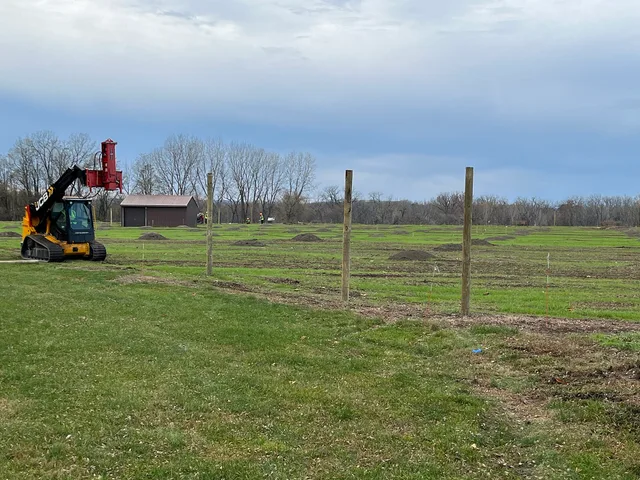
A good version is a short marked run on ground that is not level, with the scope stating a post spacing and a total length that do not divide evenly. The ambiguity is where the odd bay goes. There is no trick answer. What you are watching for is whether they notice, and what they do about it.
Have a second, safety facing element: locate marks present on the ground, with one post position marked close to a mark. The correct behavior is to raise it rather than to dig.
What to observe, and what it tells you
Do they measure or estimate?
Do they check their own work?
What happens at the ambiguity?
What happens near the locate mark?
How do they treat the site?
How do they talk about previous work?
Scoring it honestly
- Write the criteria before the first candidate arrives, and give each a pass, marginal or fail rather than a score out of ten.
- Run the identical task for every candidate, on comparable ground.
- Record what you observed, not what you concluded. "Did not check the second face" is a record; "sloppy" is an opinion.
- Treat the safety item as a veto rather than as a weighting.
- Decide against the rung you are hiring for, using the ladder in the fence contractor hiring and training guide, not against a general impression.
- Keep the records. They are useful when the same candidate applies again, and they are what shows your process was consistent.
Staying inside the rules while you do it
The U.S. Equal Employment Opportunity Commission: Small Business Resource Center sets out the anti-discrimination obligations that apply to small employers, covering how candidates are assessed and what records are kept. A structured, identical assessment applied to everyone helps here as well as helping you hire well.
Paid assessment time is time worked. The U.S. Department of Labor: New and Small Businesses compliance assistance material covers federal wage and hour rules for new employers, including how hours worked and records are treated. Do not run an unpaid trial shift on a live job.
For pay expectations, the U.S. Bureau of Labor Statistics: Occupational Employment and Wage Statistics Tables publish employment and wage estimates by occupation, industry, state and metropolitan area, useful for checking that what you intend to offer is plausible where you work.
Whether a particular person may lawfully operate specific equipment is a separate question that belongs with the compliance side of fence work, and what they will be asked to operate follows from the fence contractor equipment and setup guide and the daily kit in the equipment checklist for new owners.
After the hire
The assessment tells you the starting rung and nothing more. What makes somebody reliable is a first month with definite tasks, definite checks and honest feedback, rather than being handed a shovel and observed from a distance.
Set the first four weeks as a sequence: safety and site conduct, materials and hand digging, setting and plumbing, then panel work. Sign each off against a physical check rather than against a conversation.
The response that ends an assessment
Any move to break ground near a locate mark without raising it first. Not because the candidate lacks training, but because the behavior under mild time pressure is the behavior you will get on a real job when the pressure is real. Everything else on the assessment can be taught. This one is a judgment you are hiring, not a skill you are providing.
Common questions
Should I pay for the assessment?
Yes. It is work, it is short, and paying for it removes any question about whether you were getting free labor. It also improves the quality of candidate who turns up.
What if nobody passes?
Then you have learned something about your pay, your advertisement or your local market, and you have avoided a bad hire. An empty seat is expensive. A wrong hire on a fencing crew is more expensive, because it shows up in callbacks.
Can I assess someone with no trade experience?
Yes, with a task pitched at the first rung. You are testing care, honesty and measurement habits, none of which require experience. Skill is trainable; the safety judgment around a locate mark is what you are really screening for.
How much notice does the assessment give of long term reliability?
Not perfect notice, but far better than an interview. Combine it with a defined first month and honest checks, and most of the mistakes surface early enough to correct.